Does the ADORA2A Caffeine Gene in My 23andMe Raw Data Explain Why Coffee Keeps Me Awake
ADORA2A (rs5751876) codes for an adenosine receptor caffeine blocks, but studies disagree and the effect is small. Here is what your 23andMe file can and cannot say, and what it says about jitters.
Your 23andMe file shows your ADORA2A letters, but they explain little of why coffee keeps you up or makes you jittery. ADORA2A (commonly rs5751876) codes for the adenosine A2A receptor, one of the places caffeine acts, and some studies link it to caffeine-related anxiety and poor sleep. The evidence is mixed and the effect is small, so a raw data file cannot tell you whether your 9 pm coffee is the reason you are awake at 2 am.
The same goes for jitters. How jittery coffee makes you tracks the dose and how anxiety-prone you already are. ADORA2A is the receptor most tied to caffeine-related anxiety in studies, so it is a reasonable gene to look at, but it is one small factor next to the size of the cup.
Two genes, two different questions
The longer you stay awake, the more adenosine builds up in the brain. It binds to its receptors and raises sleep pressure. Caffeine looks enough like adenosine to sit in those receptors and block them, without switching them on. It does not remove the adenosine, so when the caffeine wears off the block lifts and the sleepiness it was covering can return. The A2A receptor is especially dense in a deep brain region called the striatum, and it is tied to arousal and to anxiety-related circuits.
CYP1A2 is a different gene and a different question. It makes the liver enzyme that breaks caffeine down, so it covers clearance, how long the caffeine stays in your blood. Its common variant, rs762551, mainly affects how much the enzyme is induced, notably in smokers, and its link to caffeine-disrupted sleep is weak. ADORA2A is the gene the sleep-sensitivity studies point to. The two are not ranked against each other: ADORA2A is about the target, CYP1A2 is about the clock.
| ADORA2A (rs5751876) | CYP1A2 | |
|---|---|---|
| What it codes for | Adenosine A2A receptor, a target caffeine blocks | Liver enzyme that breaks caffeine down |
| Question it speaks to | How the brain responds to caffeine | How long caffeine stays in the blood |
| Strength of evidence | Mixed, small effect | Solid for clearance, weak for sleep |
| In the free HealthOSX report | No | Yes |
Scroll the table sideways for the rest →
ADORA2A and CYP1A2 answer different questions about the same coffee.
What your raw file can and cannot tell you
The raw file gives you a pair of letters for each position it tests. For rs5751876, 23andMe reports the alleles as C or T on the plus strand, so you will see CC, CT or TT. There is no interpretation attached. Whether rs5751876 is in your file at all depends on the chip version. To see your own letters, upload your file to the lookup at healthosx.com/dna/lookup and search for rs5751876, or open the text file and search for the rsID yourself. A pair of dashes means the position was not called.
Papers name the same variant in different ways, such as 1976T>C or 1083T>C, or report it on the opposite strand. Before you match your letters to a study, check which strand and which allele naming the study used.
What the main studies found, with that caveat:
- Sleep. Rétey and colleagues (2007, Clinical Pharmacology and Therapeutics) used the 1083T>C naming for this variant and compared sleepers who differed in caffeine sensitivity, reporting a difference in C/C versus T/T frequency between the groups. The study was small and partly based on self-report.
- Anxiety. Alsene and colleagues (2003, Neuropsychopharmacology) reported more anxiety after a caffeine dose in people with the T/T genotype, in a small sample of light caffeine users. Childs and colleagues (2008, Neuropsychopharmacology) found an association between ADORA2A variants, including rs5751876, and caffeine-induced anxiety, again with the T/T group showing more.
So the genotype tied to the sleep result and the one tied to the anxiety result are not obviously the same, and later studies have not always reproduced either. The studies are small, lean on self-report, and have not agreed on which version is the sensitive one. Both versions are common.
If your result is CT, the studies tell you very little. CT is the most common result, roughly half of people of European ancestry (CC and TT split the rest, and frequencies differ by ancestry), and it carries no lean either way. Whichever letters you have, treat them as a weak nudge in the odds, not a label. What is still unknown is how much of the difference is the gene and how much is everything else people in those studies were doing. A genotype is only a genotype: nothing in the file knows how much you slept, what you took this morning or how many cups you drink.
How much of a 9 pm coffee is left at 2 am
Caffeine's half-life is usually somewhere between 3 and 7 hours. That spread comes from many factors, including smoking, medication, pregnancy and liver function, and CYP1A2 genotype alone does not produce a 3 versus 7 hour gap. Take 200 mg at 9 pm. By 2 am a fast clearer might have around 60 mg left. A slow clearer would still hold around 120 mg, which is still plenty to be felt.
Illustrative, not measured data. Assumes a simple half-life of 3 hours (fast) and 7 hours (slow) with no other factors. Real half-lives vary with many factors, including smoking, medication, pregnancy and liver function, not CYP1A2 genotype alone.
Controlled studies of evening caffeine report a longer time to fall asleep and less deep sleep. In one, caffeine taken six hours before bed still cut sleep time measurably (Drake and colleagues, 2013, Journal of Clinical Sleep Medicine). That pattern looks the same whichever gene is responsible, which is why a sleep graph alone cannot tell you which one it was.
What usually matters more than the gene
- Sleep debt. The more sleep debt you carry, the more coffee is propping you up. Stopping the coffee unmasks that debt, often with withdrawal tiredness for a few days.
- Anxiety. If you are already prone to anxiety, a stimulant dose feels worse, whatever your genotype. Jitters are often a dose problem.
- Medication. Some drugs slow caffeine clearance a great deal, including fluvoxamine and ciprofloxacin. Oral contraceptives and pregnancy slow it too, and smoking speeds it up. Worth asking a pharmacist or doctor if you take anything regularly.
- Habit. Daily drinkers develop tolerance. Skip a few days and the same cup hits much harder.
ADORA2A describes the receptor caffeine lands on. It says nothing about how long the caffeine stays or how tired you already were.
So what does the free report cover, and what can I test myself?
The free report at /dna does not cover ADORA2A. It does cover CYP1A2, the clearance gene, and the AHR / CYP1A2 region, which relates to how much coffee people tend to want. These speak to a different part of the question, how long caffeine lingers and how much people drink, rather than how the brain responds to it.
If you want an answer from your own body rather than a gene, run a plain experiment:
- Move your last caffeine to before noon for two weeks and change nothing else.
- Keep the dose the same, and note bedtime and how long you took to fall asleep.
- Then put the cup back at 4 pm for a few days and compare.
If the change is clear, the mechanism hardly matters.
Where to look next
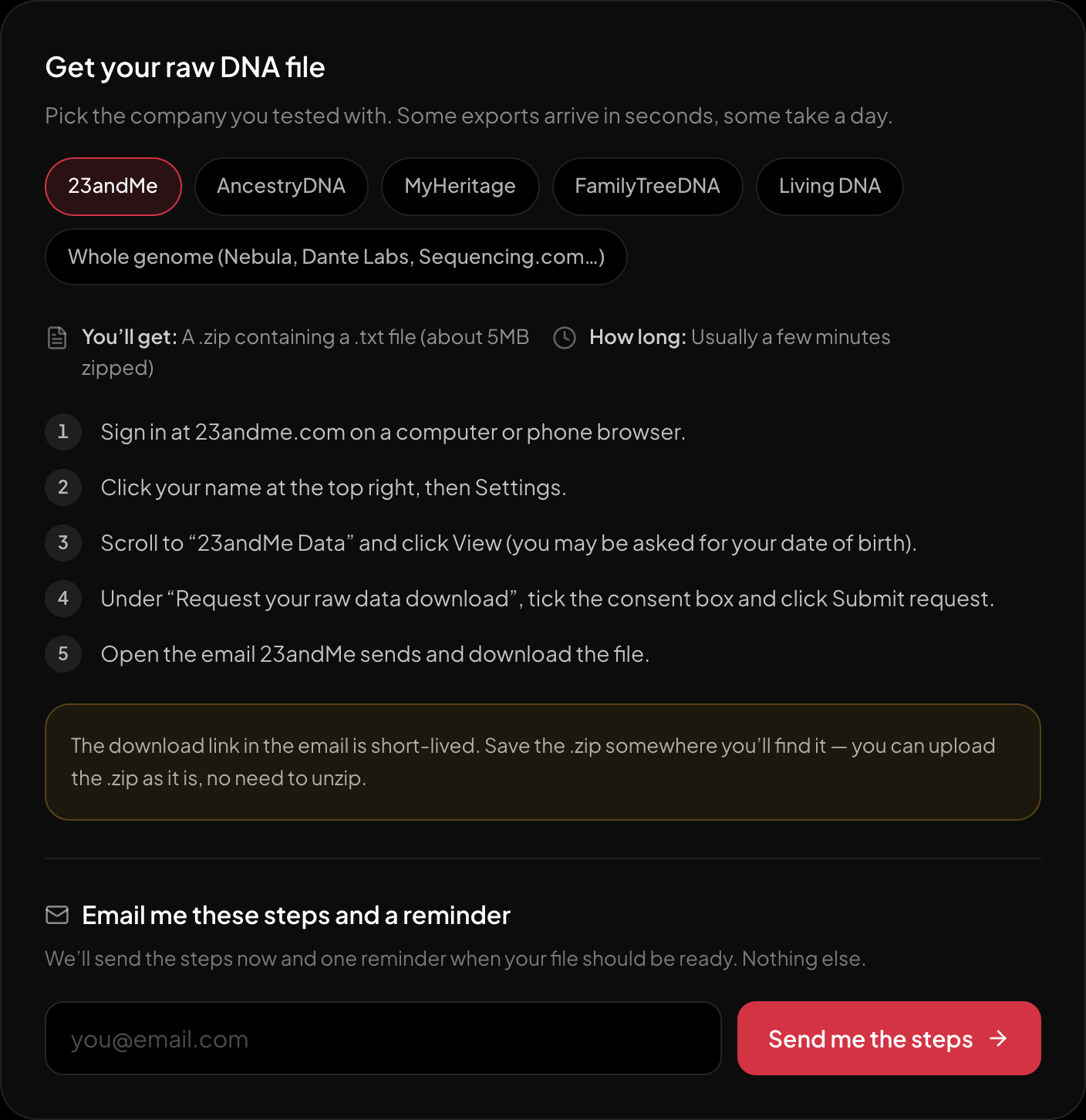
The download steps for 23andMe, on the page itself.

The short version: what is worth acting on, first.
If you want to see the genetics of coffee in your own numbers, the free tool at healthosx.com/dna reads a raw 23andMe, AncestryDNA, MyHeritage or whole-genome VCF file in your browser and reports traits, medication response and carrier-relevant findings, with an optional ancestry breakdown. No file yet? The HealthOSX saliva kit is a genotyping chip for ancestry and traits, with results delivered to your HealthOSX account. It does not come with a health report.
New to raw DNA files? Start with the full guide: 23andMe Raw Data Interpretation Free in Your Browser
Written by
HealthOSX Research