What ADH1B rs1229984 Means in Your 23andMe or AncestryDNA Raw Data and Does It Explain Alcohol Flushing or Low Tolerance
ADH1B rs1229984 (His48) speeds up the first step of alcohol breakdown. On the plus strand, CC is typical, CT is one fast copy and TT is two. It can add to flushing, but ALDH2 rs671 is the flush gene to check first.
In a 23andMe or AncestryDNA raw file, rs1229984 is reported on the plus strand: CC is the typical Arg/Arg result, CT is one copy of the fast His48 allele, and TT is two copies. That is a common variant that speeds up the first step of alcohol breakdown. It can add to flushing, but the main flushing gene is ALDH2 rs671, and neither result is a diagnosis of anything.
A fast ADH1B alone rarely explains a red face
A fast ADH1B on its own rarely causes a strong flush. Flushing is caused by acetaldehyde piling up, and what clears acetaldehyde is a different enzyme, ALDH2. ADH1B is one of several ADH enzymes that make acetaldehyde from ethanol, and the His48 version makes it faster. A fast ADH1B with a normal ALDH2 sends a bigger wave of acetaldehyde into a system that mops it up fine. A fast ADH1B with a weak ALDH2 is where it can matter, because the wave arrives faster than the drain can handle.
So if you are looking at your raw data because alcohol makes your face go red, look at ALDH2 first. Treat ADH1B as the second, smaller piece.
What the His48 variant actually does
Alcohol breakdown is two steps. ADH enzymes convert ethanol to acetaldehyde. Then ALDH2 converts acetaldehyde to acetate, which the body burns for energy. Acetaldehyde is the toxic one in the middle: it causes the flush, the racing heart and the nausea, and it is a major reason heavy drinking is linked to oesophageal cancer, though it is one contributor among several.
The rs1229984 variant swaps one amino acid in the ADH1B enzyme, arginine for histidine at position 48 (you will also see it called Arg47His, because papers count the position differently). The histidine version works many times faster in the test tube, and the exact fold change depends on the conditions used. In the body as a whole, differences in how fast alcohol is eliminated between genotypes are modest. What changes most is how quickly acetaldehyde appears.
The His allele is common in East Asian populations, at roughly 70%. It is about 20 to 30% in Ashkenazi and some other Jewish groups, and lower in most other Middle Eastern populations. It is under 5% in most European populations. These are approximate figures from population databases such as the 1000 Genomes Project and gnomAD, and they vary by group. Across studies, carrying the His allele is associated with drinking less and with substantially lower odds of alcohol dependence, a finding summarised in a 2011 meta-analysis by Li and colleagues in Biological Psychiatry. That is a statistical tilt across large groups, not a rule for one person.
Some studies also link the His allele itself to flushing, even when ALDH2 is typical, which is why the table below calls ADH1B a partial flush gene rather than a non-factor. The effect is usually smaller and less consistent than the ALDH2 one.
| Genotype | Raw file (plus strand) | Enzyme speed | What it can say |
|---|---|---|---|
| Arg/Arg | CC | Typical, slower first step | The common result in Europeans. Check ALDH2 rs671 for flushing. |
| Arg/His | CT | Faster first step | Acetaldehyde is made sooner. Lower odds of dependence in studies; a group effect. |
| His/His | TT | Fastest first step | Strongest association with lower dependence in studies, still a group effect. |
Scroll the table sideways for the rest →
Raw-file letters are on the plus strand. On the other strand His is A, so a G/A result reads the same way.
Reading the genotype, and why the letters look different
Your raw file lists rs1229984 with two letters. Three things trip people up.
- Strand. The variant is written C/T on the plus strand and G/A on the other. These are the same variant seen from opposite sides. In the C/T orientation the His allele is T, and in the G/A orientation it is A. Because C/T and G/A are not ambiguous pairs, you can always convert: C pairs with G, T pairs with A.
- Chip version. 23andMe and AncestryDNA use different arrays, and versions of each change over time. This SNP is not guaranteed to be on every one. If you search the file for rs1229984 and find nothing, it was not measured, so don't read the absence as a typical result.
- Source naming. One page calls the allele His, another calls it ADH1B*2, another gives only a letter. Check which strand the page you are comparing against uses before deciding you have the variant.
A no-call, shown as two dashes, means the chip could not read the position. It does not mean you are Arg/Arg.
ADH1B or ALDH2: which one to check for flushing
Check ALDH2 rs671. On the plus strand, GG is typical, GA is one copy of the variant and AA is two copies. According to 1000 Genomes and gnomAD, the variant allele is roughly 15 to 30% in East Asian populations and near zero elsewhere. It makes the clearing enzyme far weaker. Because the defect is dominant, one copy leaves only a small fraction of normal ALDH2 activity, and two copies leave very little. That is the classic alcohol flush, often with palpitations and nausea after one drink.
| ADH1B rs1229984 | ALDH2 rs671 | |
|---|---|---|
| Step it controls | Ethanol to acetaldehyde | Acetaldehyde to acetate |
| Raw file letters (plus strand) | CC typical, CT one copy, TT two copies | GG typical, GA one copy, AA two copies |
| Variant effect | Enzyme works faster | Enzyme works far slower |
| Common in | East Asian (roughly 70%), Ashkenazi Jewish (roughly 20 to 30%), under 5% in most Europeans | East Asian (roughly 15 to 30%), near zero elsewhere |
| Main flush gene | Partial | Yes |
| In the free HealthOSX report | No | Yes |
Scroll the table sideways for the rest →
ALDH2 is the stronger flush gene. ADH1B is not interpreted in the free HealthOSX report.
A useful rule of thumb: ADH1B changes how quickly the acetaldehyde is made, ALDH2 changes whether it can be cleared. If you flush hard and your ALDH2 is typical, ADH1B alone is unlikely to be the whole story, so check the other causes listed in the next section: rosacea, drug interactions, and histamine or sulfite reactions.
Low tolerance has more causes than this one gene
The common mistake is reading a single SNP as a verdict on how you handle alcohol. Tolerance depends on body size, sex, food in the stomach, how often you drink, liver health, medication and more. Flushing has its own non-genetic causes:
- Rosacea or a general tendency to flush
- Drugs that block acetaldehyde clearance, such as disulfiram, and cephalosporin antibiotics with an N-methylthiotetrazole side chain, such as cefotetan
- Histamine or sulfite reactions to particular drinks, especially wine and beer
That last one is a good test. If you flush only with certain drinks and not with others, acetaldehyde is a weaker explanation.
What it cannot tell you
The His48 variant is not a diagnosis of an alcohol problem and does not protect anyone from one. People carrying it still develop alcohol dependence. Its association with lower dependence is a population effect, and how much it matters for any individual is still argued about. It also says nothing about liver damage, and it does not make drinking safer.
If you flush and you carry the ALDH2 variant, the acetaldehyde exposure is linked to a higher oesophageal cancer risk, so mention that link to a doctor rather than guessing at it. Do not take H2 blockers such as famotidine to mask the flush, because the flush is a warning sign and hiding it can lead you to drink more.
The common African variant of this gene is a different SNP (rs2066702), so a result at rs1229984 does not cover everyone. Anyone with a worrying drinking pattern or an odd reaction should talk to someone who can examine them, because a raw file cannot.
Where to check your own file
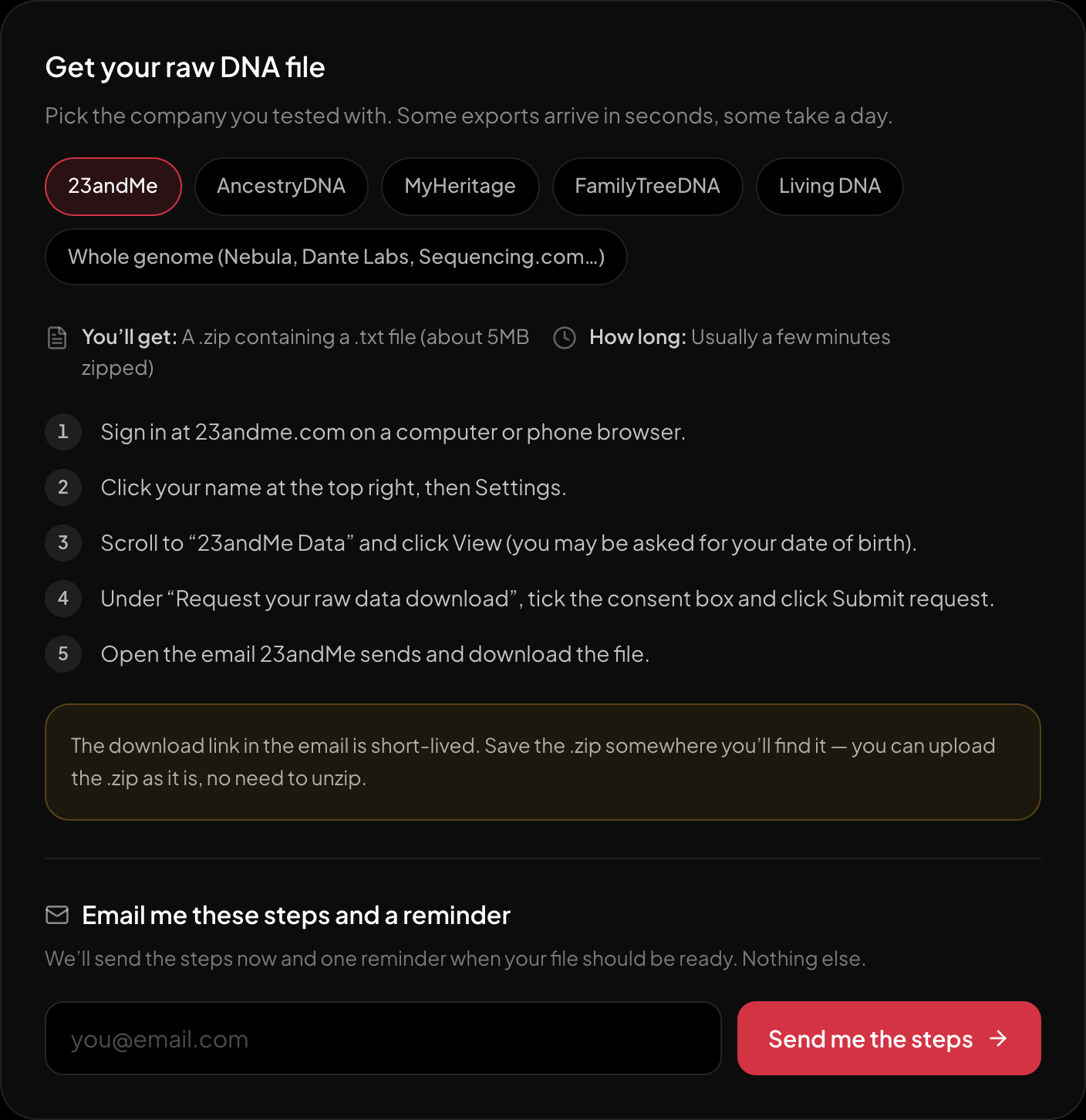
The download steps for 23andMe, on the page itself.
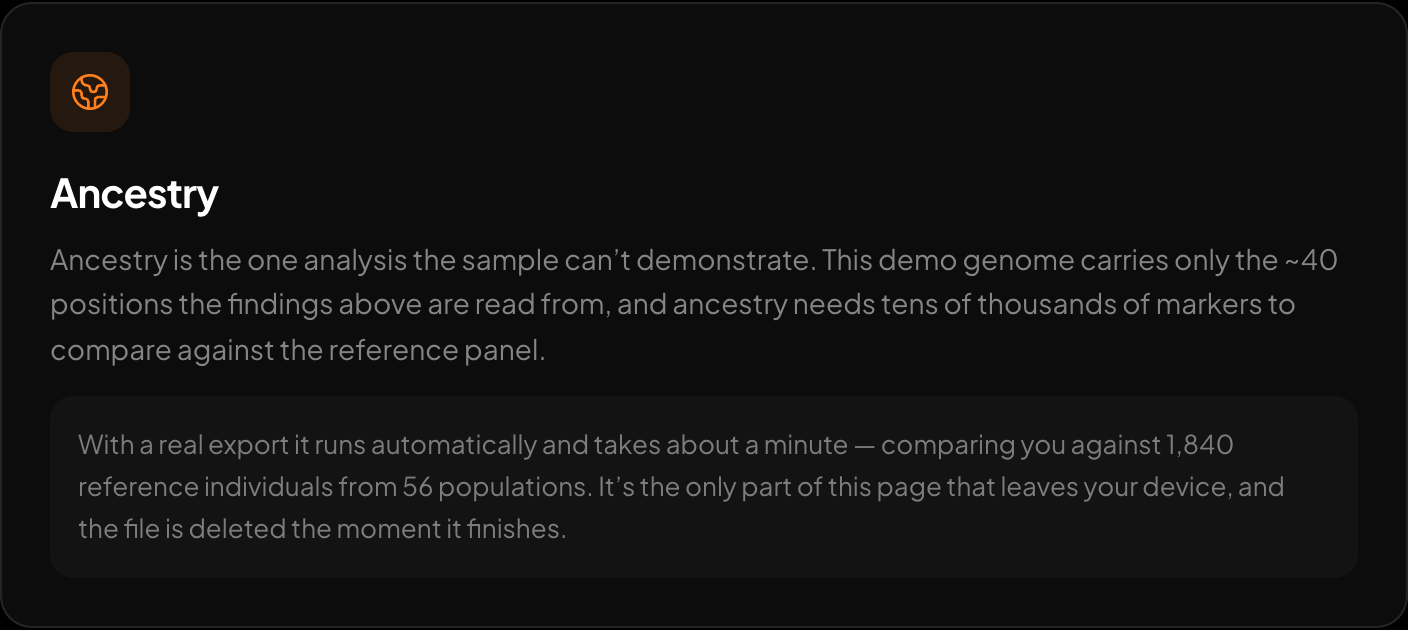
Ancestry across 15 regions and 157 reference populations.
You do not need to search the raw file by hand. The HealthOSX DNA lookup lets you look up rs1229984 in your own file. If you chose to store your file, Ask your DNA can look up any variant for you. The free report at HealthOSX covers ALDH2, the flush gene, along with medication response and carrier-relevant findings. It does not interpret ADH1B, so use the lookup and the strand notes above to read that one.
New to raw DNA files? Start with the full guide: 23andMe Raw Data Interpretation Free in Your Browser
Written by
HealthOSX Research