Can My 23andMe or AncestryDNA Raw Data Show My 5-HTTLPR Serotonin Transporter Genotype
5-HTTLPR is a length variant in SLC6A4, not a single-letter SNP, so 23andMe and AncestryDNA files usually do not report it. Proxies are imperfect and the mood claims did not replicate.
Your 23andMe or AncestryDNA raw data almost certainly does not contain your 5-HTTLPR genotype. 5-HTTLPR is an insertion/deletion of roughly 43 to 44 base pairs (both figures are used in the literature) in the promoter of the serotonin transporter gene SLC6A4, giving a long (L) and a short (S) allele, and genotyping chips are built to read single letters, not stretches of repeated sequence. A nearby SNP can stand in for it in some populations, but it cannot replace it, and the genotype is not a verdict on your mood or on how an antidepressant will work for you.
Why searching your raw file for 5-HTTLPR finds nothing
Open a raw file and search for "5-HTTLPR" and you get nothing. The file is a list of rsIDs with one genotype each, like AG or CC. 5-HTTLPR is not a letter swap. The promoter contains a block of repeated sequence, and the S allele is missing two repeats of it that the L allele has (14 versus 16 repeats). A chip probe works by detecting which base sits at one position. A length difference in a repetitive region does not give it a clean signal, so the variant is usually left off or called unreliably.
Some databases attach an rsID to the polymorphism (rs4795541 is sometimes used), and a second SNP, rs25531, sits inside the L allele. Even if either ID appears in your file, treat the call with suspicion unless the provider documents how it was made. A missing line is the normal result, not a fault with your download.
A step you can take yourself: paste rs4795541 and rs25531 into the lookup at healthosx.com/dna/lookup to check whether either one is in your file at all. Be clear about what a hit means. It shows that a genotype line exists for that rsID. It is not a validated L/S call, and it does not tell you your 5-HTTLPR genotype.
What the gene does, and why length matters
SLC6A4 codes for the serotonin transporter, the protein that pulls serotonin back out of the synapse. SSRIs block it. The promoter decides how much transporter gets made. In cell studies the S allele drives less transcription than the L allele, so the idea was that S carriers have less transporter available.
A single-letter variant inside the L allele, rs25531 (A or G), changes things again. The LG version behaves more like S in those cell experiments. So the real picture is three functional groups, not two, and a lot of older studies never typed rs25531.
Allele frequencies differ a lot by ancestry. S is rarer in African-ancestry populations and most common in East Asian ones, as the table shows. Most people of European or East Asian ancestry carry at least one S allele.
| Ancestry | S allele frequency | Carriers of at least one S |
|---|---|---|
| European | ~40% | ~64% |
| African or African-American | ~20-25% | ~36-44% |
| East Asian | ~70-80% | ~90% or more |
Scroll the table sideways for the rest →
Approximate figures from population surveys such as Gelernter et al. 1997 (Human Genetics), which sampled African-Americans among other groups. Exact values vary by study and sample. Carrier shares are computed from the allele frequency assuming Hardy-Weinberg equilibrium, not measured directly.
What the nearby proxy SNPs can and cannot stand in for
When a variant is not on the chip, researchers look for a SNP that travels with it, a proxy in linkage disequilibrium. For 5-HTTLPR, such proxies have been proposed, with imperfect concordance.
- A proxy is a statistical correlation, not a reading of the real thing. Some people carry the SNP without the matching length allele.
- Any correlation was measured in specific populations. In other ancestries it can be weaker, and you cannot tell from your own file.
- Whether a given proxy is on your chip depends on the chip version. Check by searching the file for the rsID.
- A proxy cannot sort out the rs25531 split unless the study built it in.
A proxy is fine for a research cohort of thousands, where small error averages out. For one person's genotype it is a guess with decent odds.
| Reads the length directly | Notes | |
|---|---|---|
| 23andMe or AncestryDNA chip file | Usually no | Single-base probes; the indel is normally absent |
| Proxy SNP in linkage disequilibrium | Estimated | Imperfect concordance, measured in specific populations |
| Targeted lab assay or long-read sequencing | Yes | Repeat length is measured, mostly used in research |
| Short-read 30x WGS VCF | Unreliable | Short reads often miscall this repeat region |
Scroll the table sideways for the rest →
Qualitative summary. Proxy reliability depends on the chip and on ancestry.
If you really want the genotype, ask a clinical or research lab for a targeted PCR assay of the repeat, or for long-read sequencing. A standard 30x short-read whole-genome VCF often miscalls this repeat region too, so a WGS file is not a guaranteed fix.
The depression and stress studies did not hold up
The reason anyone cares about this variant is a 2003 paper by Caspi and colleagues, which reported that S carriers who went through stressful life events were more likely to become depressed. It was influential and it set off hundreds of follow-ups. Later work did not find the interaction holding up: Risch et al. 2009 (JAMA), a meta-analysis, Culverhouse et al. 2018 (Molecular Psychiatry), a large consortium analysis, and Border et al. 2019 (American Journal of Psychiatry), which tested candidate genes for depression including SLC6A4, all failed to support it. Many researchers now regard it as an early finding that did not replicate. Candidate-gene results of this kind, one variant and one big psychological outcome, have had a poor track record in general.
What does survive is more modest: 5-HTTLPR changes expression of the transporter in a dish, and there is some work on brain responses to emotional faces. How big those effects are in real life, and whether they matter for anyone's day-to-day mood, is still argued about.
A length variant in the serotonin transporter promoter is a research curiosity, not a mood result and not an antidepressant guide.
Does my genotype tell me which antidepressant to take?
No. The 2023 CPIC guideline for SSRIs and SNRIs covers CYP2D6, CYP2C19 and CYP2B6, liver enzymes that change how fast a drug is cleared. Those are real, testable gene-drug links. CPIC reviewed SLC6A4 and HTR2A and did not make recommendations for them. Commercial psychiatric gene panels that still report SLC6A4 therefore go beyond the CPIC recommendations. Being SS, SL or LL does not predict whether sertraline or escitalopram will work, and it should not be used to talk yourself into or out of a medication. If you are depressed or on treatment, that conversation belongs with a prescriber, and the CYP2C19 result is the part worth bringing.
The common mistake is reading "short allele" as "vulnerable" or "anxious." Carrying S is common, most carriers are fine, and no file can tell you otherwise.
What you can read from your file
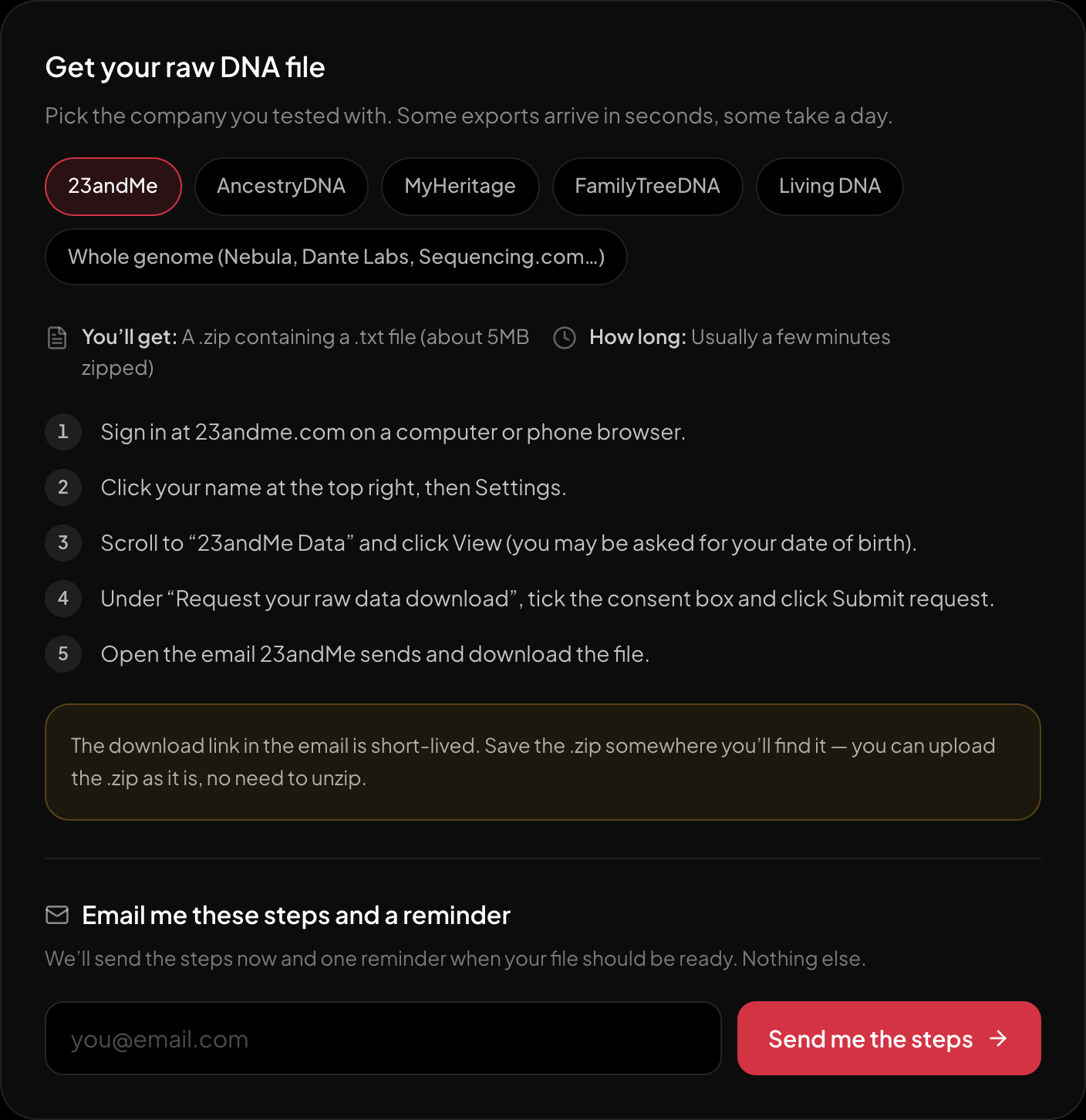
The download steps for 23andMe, on the page itself.
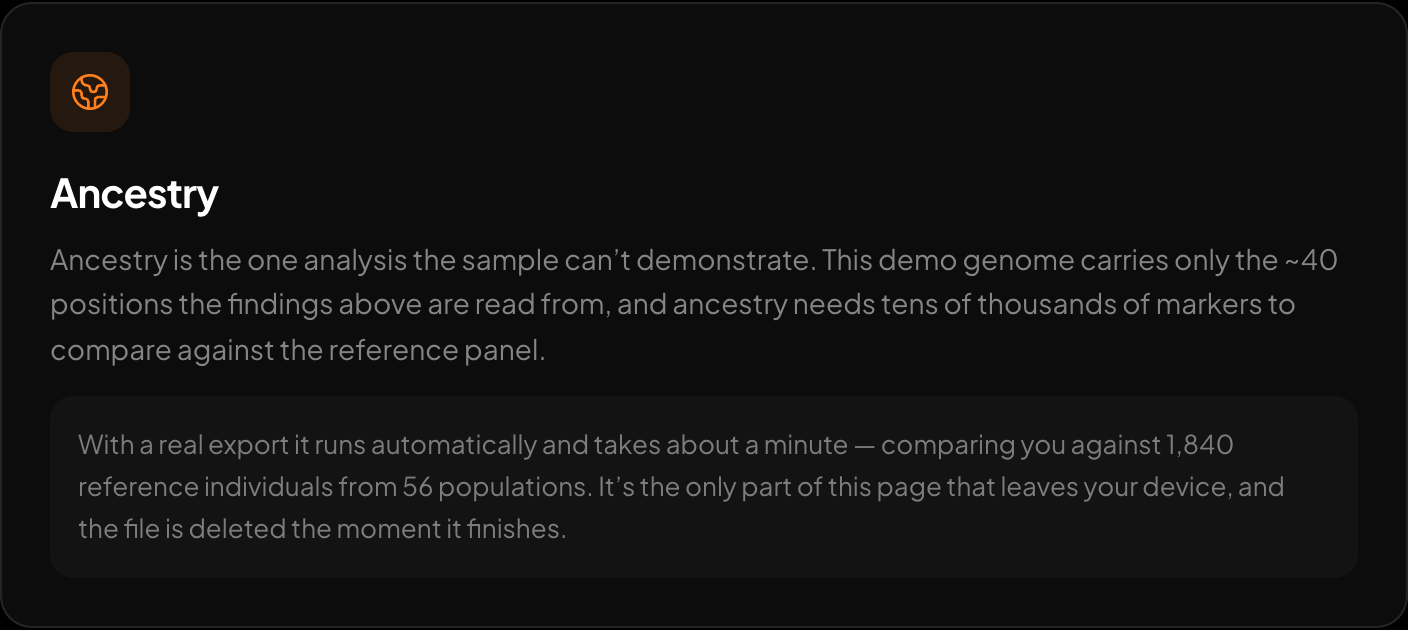
Ancestry across 15 regions and 157 reference populations.
SLC6A4 is not among the findings the free tool at HealthOSX reports, so it will not hand you a 5-HTTLPR call. If you want to see what your raw 23andMe, AncestryDNA, MyHeritage or whole-genome VCF file actually supports, run it through the free DNA tool at healthosx.com/dna. The trait and health story appears in the browser. The full report, where drug-by-drug CPIC medication response is listed, opens after a one-time email code.
New to raw DNA files? Start with the full guide: 23andMe Raw Data Interpretation Free in Your Browser
Written by
HealthOSX Research