Can My 23andMe or AncestryDNA Raw Data Tell Me Which Antidepressant or SSRI Will Work for Me
A 23andMe or AncestryDNA file can show how you break down citalopram or sertraline, but not whether a drug will work. Here is what to look up and what to leave alone.
No. A 23andMe or AncestryDNA raw data file cannot tell you which antidepressant or SSRI will work for you. At best it can show how fast your liver clears some of them, mainly through CYP2C19 and CYP2D6, and that points to dose and side-effect risk, not to benefit. Guidance from CPIC (the Clinical Pharmacogenetics Implementation Consortium) is built on exactly that distinction.
This post covers only CYP2C19 and CYP2D6. The 2023 CPIC guideline also gives CYP2B6 recommendations for sertraline, which are not covered here.
Clearance speed, not whether the drug works
Your file can say something real about pharmacokinetics: how quickly your body removes a drug, which decides how much of it sits in your blood at a given dose. It says very little about pharmacodynamics: whether raising serotonin will lift your depression. Response depends on the illness itself, sleep, other medication, adherence, time, and a large number of genes that each nudge the result by a sliver.
So a genotype can say "this person may reach higher blood levels of escitalopram than average". It cannot say "escitalopram will work" or "sertraline will fail". Anyone who sells it that way is going beyond what the evidence supports.
What CYP2C19 changes, and what it does not
CYP2C19 is a liver enzyme that clears citalopram, escitalopram and sertraline. Variants sort people into rough speed groups:
- Poor metabolizers carry two non-working copies (such as 2 or 3). Drug stays higher for longer. For citalopram, escitalopram and sertraline, CPIC suggests a lower starting dose and slower titration, a maintenance dose about 50% lower than usual, or an alternative drug. For citalopram the FDA ceiling for this group is 20 mg/day. Higher levels raise the risk of dose-related effects such as nausea, dizziness and agitation, and of QT prolongation (a heart-rhythm change on the ECG) with citalopram, and with escitalopram at high levels.
- Intermediate metabolizers carry one non-working copy (for example 1/2). This is the most common non-normal group: roughly a quarter to a third of people of European ancestry, and more in East Asian populations. Under CPIC 2023 they start on a standard dose, and slower titration or a lower maintenance dose may be needed if side effects appear.
- Normal metabolizers get the standard starting dose.
- Rapid metabolizers carry one copy of *17. They also get the standard starting dose, and a switch is considered if there is no response.
- Ultrarapid metabolizers carry two copies of *17. Levels can run low, so the standard dose may underperform. For citalopram and escitalopram, CPIC suggests considering a drug not mainly cleared by CYP2C19. For sertraline, it suggests the standard starting dose, then a switch if there is no response.
| Group | Typical genotype | Share of people | CPIC action |
|---|---|---|---|
| Poor | *2/*2, *2/*3, *3/*3 | About 2 in 100 of European ancestry, closer to 15 in 100 in East Asian populations | Lower starting dose and slower titration, or consider another drug |
| Intermediate | *1/*2, *1/*3, *2/*17 | Roughly a quarter to a third of Europeans, more in East Asians | Standard starting dose; slower titration or lower maintenance dose may be needed |
| Normal | *1/*1 | Roughly 4 in 10 Europeans | Standard starting dose |
| Rapid | *1/*17 | Roughly a quarter of Europeans | Standard starting dose; consider a switch if no response |
| Ultrarapid | *17/*17 | A few in 100 Europeans | Citalopram and escitalopram: consider another drug. Sertraline: standard start, switch if no response |
Scroll the table sideways for the rest →
Approximate shares of people in each group, and the CPIC action for citalopram, escitalopram and sertraline. Shares vary by ancestry.
Nothing in the guidance ranks drugs by how likely they are to help.
| CYP2C19 | CYP2D6 | |
|---|---|---|
| Key SNPs on chips | *2, *3, *17 present on many 23andMe and AncestryDNA versions; check your own file | Some SNPs, no copy number |
| Reliable group from a chip | Usually | Often not |
| CPIC guidance | Dose and side-effect risk | Dose and side-effect risk |
| Predicts whether a drug will work | No | No |
Scroll the table sideways for the rest →
Qualitative summary of what chip data can and cannot support.
CYP2D6 is where a chip struggles
CYP2D6 matters for many older antidepressants (nortriptyline, amitriptyline), for paroxetine and fluvoxamine, and for two common newer drugs. CPIC 2023 covers both vortioxetine and venlafaxine, with the venlafaxine recommendation marked optional. CYP2D6 is also the hardest gene to read from a consumer file. People can have the whole gene deleted, or carry extra copies, or a hybrid with its neighbour CYP2D7. A chip reads single letters at fixed positions. It cannot count copies, so a person with three working copies and a person with one can look identical.
A CYP2D6 result from a raw file should be treated as a hint at best. Clinical labs use methods that measure copy number for this reason. If the result matters for you, ask your prescriber for a clinical pharmacogenomic test that measures CYP2D6 copy number, especially before paroxetine, fluvoxamine, vortioxetine, venlafaxine or a tricyclic.
What a result looks like, and what to do with it
In a raw file you are looking at lines like an rsID, a chromosome position and two letters. CYP2C19 2 is rs4244285, 3 is rs4986893 and *17 is rs12248560. Chip versions differ in which of these they carry, so a missing line may mean the position was never tested, not that you are normal. A "--" at rs4244285 or rs12248560 is a no-call: the position was not read, and it does not mean a normal result. A tool then translates the letters into a metabolizer group.
Things worth looking up in your own file:
- Whether the three CYP2C19 markers are present at all, and whether any shows "--".
- Which speed group they add up to.
- Whether the drug you are on or considering appears in the CPIC tables for that group.
Things to leave alone:
- Changing, splitting or stopping a dose because of a raw-data genotype.
- Reading "normal metabolizer" as "this drug will work".
- Treating a missing CYP2D6 result as a clean one.
So is a clinical pharmacogenomic panel worth it?
The evidence is modest. Randomised trials of panel-guided prescribing, including GUIDED and PRIME Care, and the meta-analyses that pool them, found small or mixed gains in remission compared with usual prescribing. Most of whatever gain exists seems to come from using metabolism genes such as CYP2C19 and CYP2D6 to guide dose and drug choice, not from predicting who will respond. A panel can be reasonable if you have had side effects or no response on a standard dose, or if your prescriber is weighing a CYP2D6 drug. Expect a small, practical help with dosing, not a verdict on which drug will work.
Why it never replaces the prescriber
A prescriber sees what your file cannot: other drugs that block the same enzymes (fluoxetine and bupropion strongly inhibit CYP2D6, so a normal genotype can behave like a poor one), liver function, age, pregnancy, past reactions and how you have actually felt on a dose. Phenoconversion like that can outweigh the genotype for CYP2D6 drugs. And antidepressants typically need several weeks to show their full effect, so the first fortnight of side effects is no verdict on the drug either way.
CPIC also reviewed other genes often sold for this purpose, including SLC6A4 and HTR2A, and did not find enough evidence to make recommendations from them. A report that confidently ranks drugs from those genes is ahead of the guideline, not behind it.
A chip file can hint at how fast you clear an antidepressant. It cannot say whether the drug will lift your mood, and it is never a reason to change a dose on your own.
Where to take it
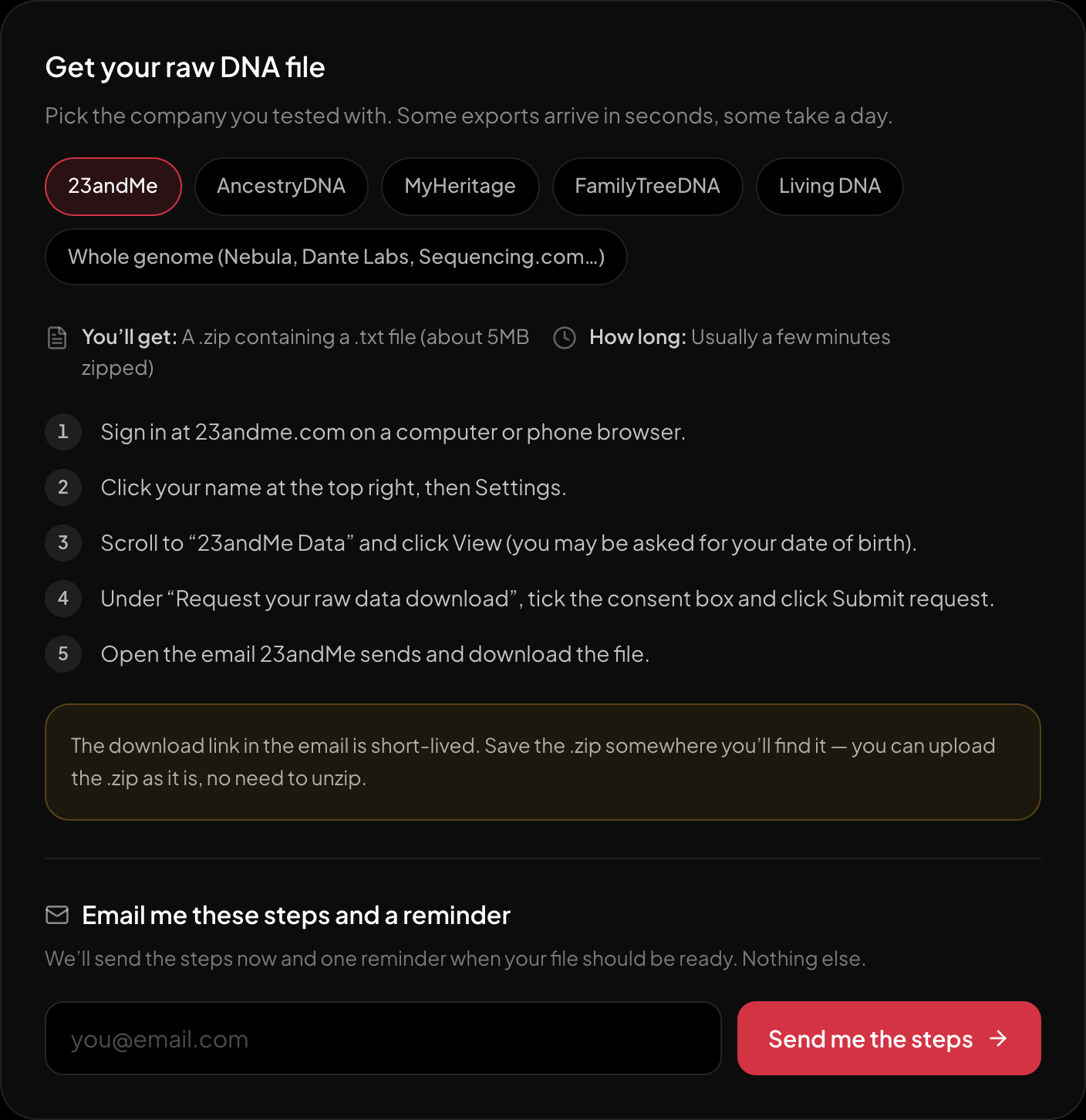
The download steps for 23andMe, on the page itself.
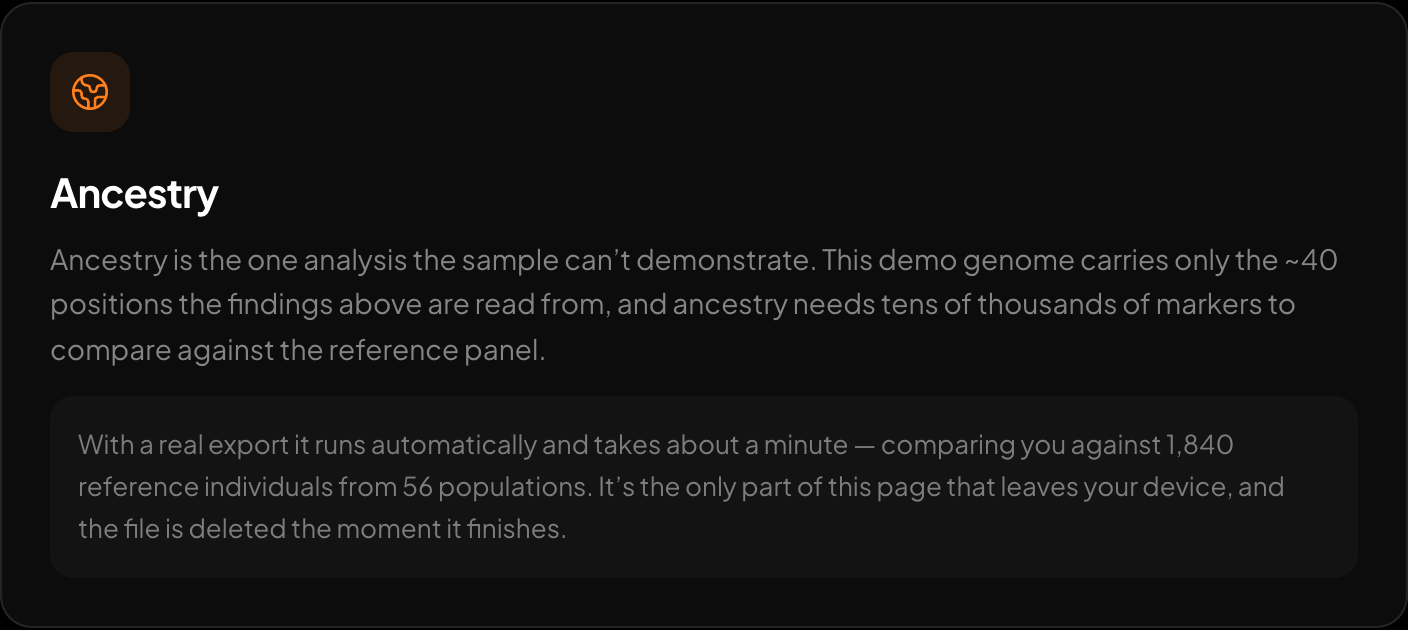
Ancestry across 15 regions and 157 reference populations.
If you want to see your own CYP2C19 result laid out, the free DNA analysis tool parses a 23andMe, AncestryDNA, MyHeritage or whole-genome VCF file in your browser, and the full report opens after a one-time email code. For CYP2C19 the /dna report shows a gene finding plus CPIC medication response, drug by drug. It does not give a ranked or personalised recommendation for any antidepressant. CYP2D6 is not in the report, which fits the copy-number problem above. Bring whatever you find to your prescriber as a question, not an instruction.
New to raw DNA files? Start with the full guide: 23andMe Raw Data Interpretation Free in Your Browser
Written by
HealthOSX Research