Can My 23andMe or AncestryDNA Raw Data Show If I Have a BRCA1 or BRCA2 Mutation
A 23andMe or AncestryDNA raw file reads only a sliver of BRCA1 and BRCA2, so no BRCA finding is not a clear result. Here is what a hit means and where a VCF differs.
Mostly no. A 23andMe or AncestryDNA raw file comes from a genotyping chip that reads a fixed list of positions, and only a handful of them fall inside BRCA1 and BRCA2, so a file with no BRCA finding does not tell you that you are clear. A whole-genome VCF reads the genes themselves and can screen far more, but even that is not a clinical test.
Can 23andMe raw data show a BRCA1 or BRCA2 mutation
It can show a few, and only a few. The BRCA report that 23andMe received FDA authorisation for in 2018 looked for three variants: BRCA1 185delAG and 5382insC, and BRCA2 6174delT. They are founder variants, common in people of Ashkenazi Jewish descent, where population studies put the carrier rate at about 1 in 40 for one of the three. Outside Ashkenazi ancestry these three explain only a small share of BRCA carriers, which is why 23andMe's own FDA labelling states that the report does not detect the many other BRCA variants and that a negative result does not rule out a mutation.
ClinVar lists thousands of BRCA1 and BRCA2 variants classed as pathogenic. So the chip checks a few entries on a very long list and stays silent about the rest. AncestryDNA does not currently offer a BRCA report. Its raw file may include some BRCA positions, but they were chosen for ancestry and general use, not to screen the genes.
| Chip raw file (23andMe, AncestryDNA) | Whole-genome VCF | Clinical BRCA test | |
|---|---|---|---|
| Reads the whole genes | No | Mostly | Yes |
| Catches large deletions and duplications | No | Some missed | Yes |
| A clean result rules you out | No | No | For known pathogenic variants, yes; VUS still possible |
| Acceptable basis for medical decisions | No | No | Yes |
Scroll the table sideways for the rest →
General comparison of the three sources, not a count of variants in any one file.
How to check your own file
You can search a 23andMe or AncestryDNA file for the three variants that the 23andMe report covered. 23andMe raw files usually list them under internal IDs rather than rsIDs, so search for both forms:
- BRCA1 185delAG: i4000377 (rsID form: rs80357914)
- BRCA1 5382insC: i4000378 (rsID form: rs80357906)
- BRCA2 6174delT: i4000379 (rsID form: rs80359550)
Chip versions differ, and some files may not contain all three, or any of them. Searching only for the rsID can turn up nothing even when the position was tested, so check both forms before you conclude a position was not covered. You can check a single rsID at the HealthOSX lookup.
Why a chip sees so little
A chip does not read your DNA. It tests a preset list of single positions, a few hundred thousand to around a million, and records which letter you have at each. Anything not on the list is never looked at. Positions not on the chip are simply absent from the file, and tested positions that failed are written as '--' in 23andMe files and '0 0' in AncestryDNA files, so in both cases a missing variant can look just like a negative one.
BRCA problems are also awkward for this design. Many harmful changes are small insertions or deletions rather than single-letter swaps, and they are scattered along both long genes instead of clustered at a few hotspots. Some are large deletions or duplications of whole exons. Published reviews of BRCA rearrangements (for example Sluiter and van Rensburg, 2011) put these at roughly 5 to 15 percent of pathogenic BRCA1 changes, with some populations, for example Dutch, running higher. A chip built around single positions was never meant to catch a pattern like that.
What a missing finding looks like in your file
Nothing. That is the whole problem. You search for BRCA1 in a viewer, find a few rows reading as the common letter, and it feels like an answer. It is only the answer for those rows.
A clean result on the three 23andMe variants means only that those three were not found. It says nothing about the thousands of others. Family history changes how much weight this deserves: a relative with breast, ovarian, prostate or pancreatic cancer, or a diagnosis young, makes a clean chip file even less reassuring.
If a BRCA variant does show up
Treat it as a lead, not a result. Raw chip data has a known error rate for rare variants, because the probes are tuned for common ones. In Tandy-Connor et al. 2018 (Genetics in Medicine), 40 percent of variants in direct-to-consumer raw data that were sent for clinical confirmation turned out to be false positives. In Weedon et al. 2021 (BMJ), chip calls for very rare variants, BRCA included, had a low positive predictive value. That is why labs insist on confirming.
- Do not act on the raw file alone, and do not discuss surgery or screening changes on that basis.
- Ask a doctor or genetic counsellor about confirmatory testing in a clinical lab.
- Bring the variant name, not just a screenshot of the gene.
- Tell relatives only after confirmation, since the news is hard to take back.
In many health systems, genetic counselling is available without paying for a consumer product first. Worth asking about, especially with family history.
When to seek testing without any file
You do not need a raw file to ask for a BRCA test. Raise it with your doctor or a genetic counsellor if any of these apply:
- A relative has a known BRCA1 or BRCA2 variant.
- You or a close relative had breast cancer at a young age.
- Ovarian cancer, pancreatic cancer or male breast cancer has occurred in your family.
- You have Ashkenazi Jewish ancestry.
Criteria differ a little between countries and health systems, so a counsellor can tell you whether you qualify.
What a whole-genome VCF changes
A VCF from whole-genome sequencing records where your genome differs from the reference across the genes, not just at preset positions. That is a different category of data for BRCA. The free reader at HealthOSX screens a VCF in your browser against ClinVar for variants classed as pathogenic or likely pathogenic in hereditary cancer genes, as one of several panels.
There are limits, and they matter:
- A clear panel means no such variant was called in your file. It is not an all-clear.
- Variants of uncertain significance are not flagged, and many BRCA findings sit in that bin.
- Short-read sequencing can miss large deletions and duplications of whole exons.
- A variant ClinVar does not yet classify cannot be flagged, and classifications get revised.
So a VCF is a much better first look than a chip, and still a screen. A clinical BRCA test uses validated methods built to catch the rearrangements and reports with a lab's accountability behind it.
The mistake people make
Reading a quiet file as a negative. The chip said nothing, so people hear no. If your family history points at BRCA, the raw file should not be what puts your mind at rest.
No BRCA finding in a 23andMe or AncestryDNA raw file means the chip did not look, not that nothing is there.
Where to go from here
If you want to see what your own file does contain, the free tool at /dna reads a 23andMe, AncestryDNA, MyHeritage or whole-genome VCF file in your browser and reports traits, medication response and carrier-relevant findings. The 56-finding report has no BRCA entry, so a chip file gets no BRCA finding there. A whole-genome VCF is screened separately against ClinVar for hereditary cancer genes, and that screen is a lead to take to a clinician, not a verdict. Ask your DNA runs a ClinVar disease-variant screen on stored files, including imputed chip files, but any BRCA hit from it would still be a chip or imputation call that needs clinical confirmation, and imputation cannot reliably recover rare BRCA variants.
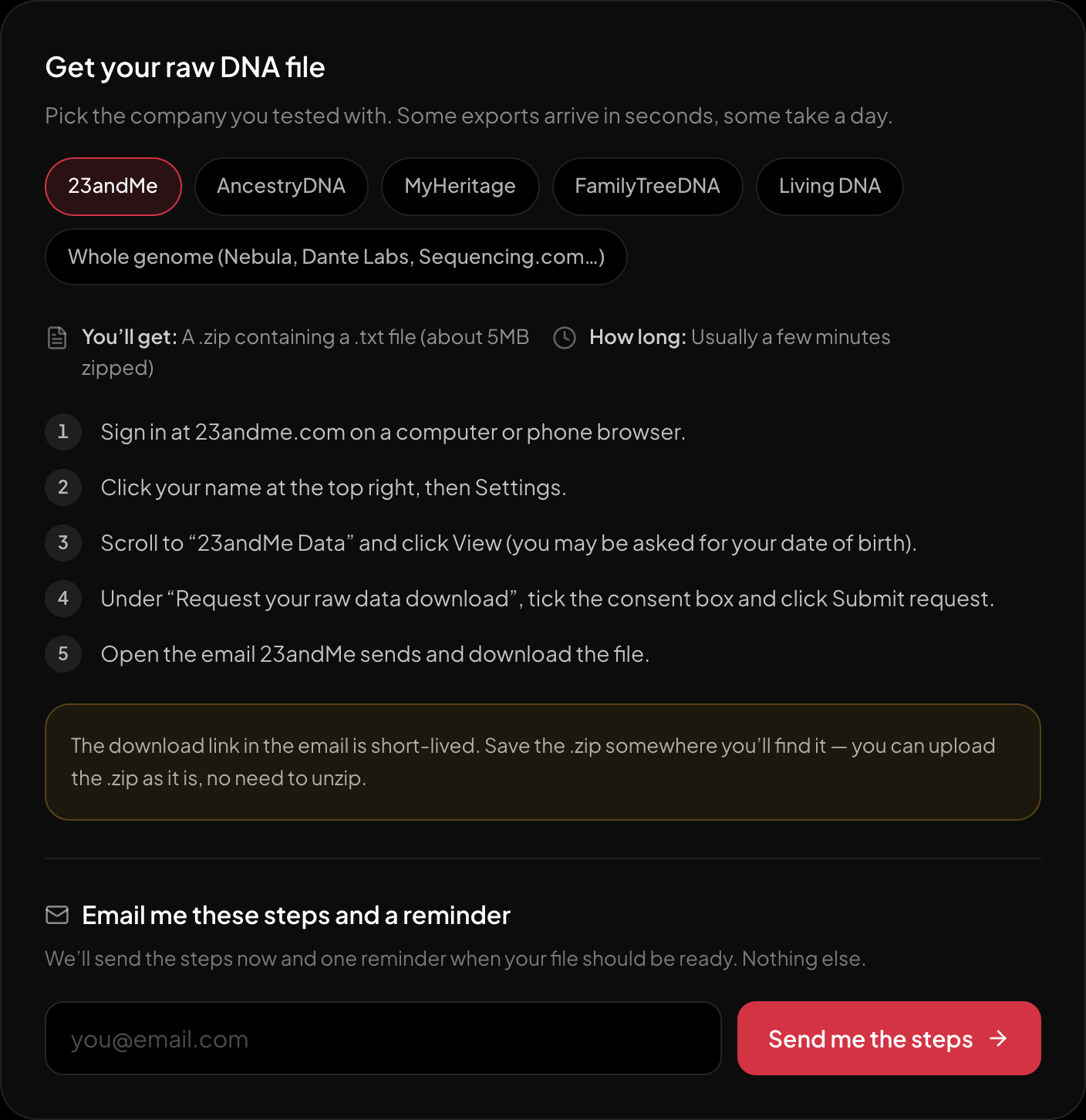
The download steps for 23andMe, on the page itself.
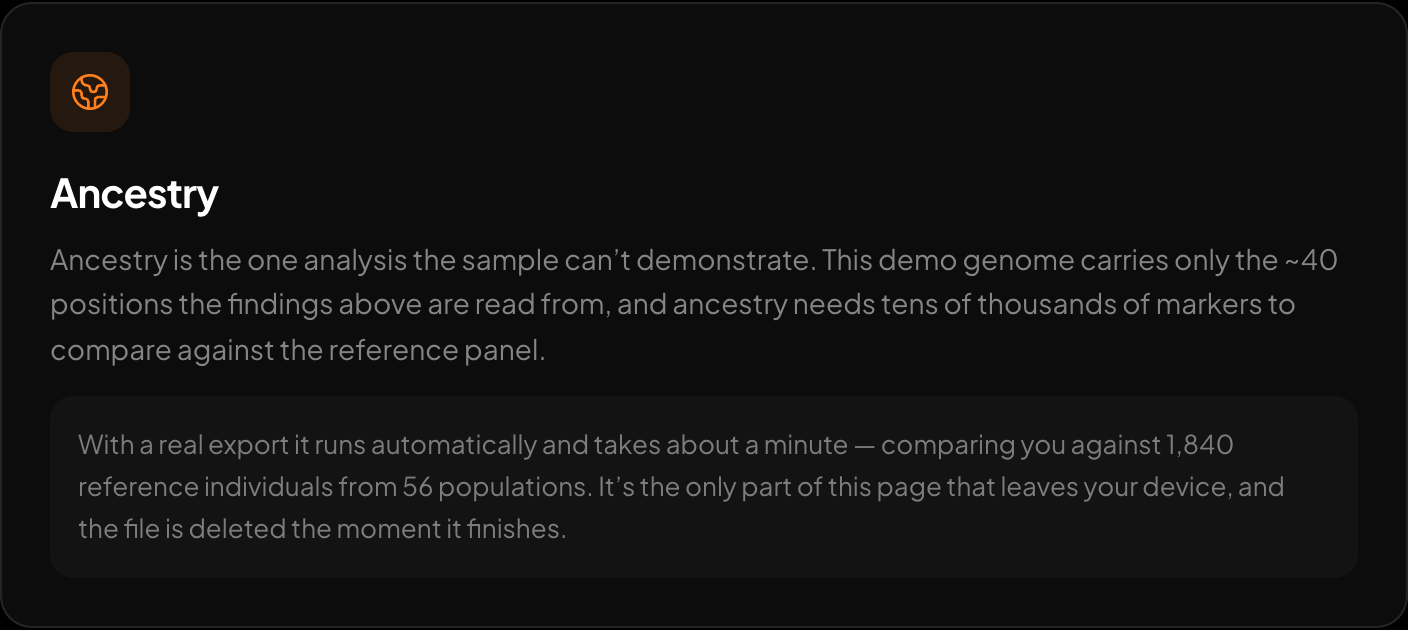
Ancestry across 15 regions and 157 reference populations.
The HealthOSX DNA Kit and Whole Genome are not health tests and will not report BRCA, so please do not buy them for that purpose.
New to raw DNA files? Start with the full guide: 23andMe Raw Data Interpretation Free in Your Browser
Written by
HealthOSX Research