Can My 23andMe or AncestryDNA Raw Data Tell Me If Metformin Will Work for Me
A 23andMe or AncestryDNA raw file cannot tell you whether metformin will work. The gene associations are small and inconsistent, and CPIC has issued no guideline for metformin.
No. A 23andMe or AncestryDNA raw data file cannot tell you whether metformin will work for you, and no result in it should change a metformin decision. The genes people usually check, the transporters SLC22A1 (OCT1) and SLC47A1 (MATE1) and a variant near ATM, have published links to response, but the effects are small and inconsistent. CPIC has issued no gene-drug guideline for metformin.
Metformin is moved by transporters, not broken down by enzymes
Metformin is unusual among drugs because your liver does not break it down. It leaves the body unchanged, mostly through the kidneys. So the genes that matter are not enzymes like CYP2C19. They are transporters, the proteins that move the drug across cell membranes.
- SLC22A1 (OCT1) helps pull metformin into liver cells, where much of its glucose-lowering action happens.
- SLC47A1 (MATE1) works mainly in the kidney, where it helps push metformin into the urine.
- ATM is not a transporter at all. A variant near it came out of a large genome-wide study of glycemic response, and the biology linking it to metformin is still unclear.
- SLC2A2 (GLUT2) encodes a glucose transporter. The variant rs8192675 was found by the MetGen GWAS (Zhou et al., Nat Genet 2016) and is the largest common-variant signal published so far, yet its effect is a few tenths of a percentage point of HbA1c at most.
A transporter that works less well should change how much drug reaches the liver, and so how well it works. Reduced-function OCT1 variants do lower metformin uptake in cell experiments. The leap from a petri dish to a person's HbA1c is where it falls apart.
| Gene | What it does | Usable for one person? |
|---|---|---|
| SLC22A1 (OCT1) | Moves metformin into liver cells | No |
| SLC47A1 (MATE1) | Works mainly in the kidney, pushing metformin into urine | No |
| SLC2A2 (GLUT2) rs8192675 | Glucose transporter; strongest common signal (MetGen GWAS), ≤ a few tenths of a point of HbA1c | No |
| ATM | Unclear link to glycemic response | No |
| CYP2C19 (for comparison) | Activates clopidogrel, a prodrug; CPIC guideline exists | Yes |
Scroll the table sideways for the rest →
Summary of what is generally reported, not a clinical interpretation.
Why metformin has no CPIC guideline like CYP2C19 or SLCO1B1
CPIC writes a gene-drug guideline only when the evidence is strong enough to tell a prescriber to do something different for a given genotype. For CYP2C19 and clopidogrel, or SLCO1B1 and simvastatin, a genotype changes a dose or a drug choice, and the effect is large and repeatable. For metformin, nobody has shown that knowing your OCT1 or MATE1 genotype lets a doctor choose a better drug or dose. Without that, there is nothing to put in a guideline.
That is the gap between a statistical association and a clinical test. A variant can be reliably linked to a slightly different average result across thousands of people and still be useless for predicting what happens to you.
The published associations are small and do not agree
Studies of OCT1 variants have pointed in different directions. Some found a weaker glucose response in carriers, some found little, and some tied reduced-function OCT1 to more gastrointestinal side effects, mainly when other drugs that block OCT1 were also being taken. Sample sizes were often modest and the populations differed. The ATM and SLC2A2 signals came from large studies, but a variant that nudges the average HbA1c change by a fraction of a point tells you almost nothing about one person, because response to metformin varies enormously between people for reasons that are mostly not genetic or not yet known.
There is also a practical problem. Consumer arrays read a fixed list of positions, and which positions are covered varies by chip version. Met420del (rs72552763), a deletion in OCT1, is one that many consumer chips do not call reliably, so a file can look clean simply because a variant was never tested properly.
A whole-genome file does not change the answer either. If you have a VCF from Nebula or Dante, the limit is still the evidence, not the chip coverage: even a complete read of these genes would not tell you whether metformin will work for you.
What actually shows whether metformin is working
Metformin gives you fast, cheap, direct feedback, which makes a genetic guess redundant. The things that tell you are measurable within weeks.
| Signal | How soon | What it tells you |
|---|---|---|
| Gut tolerance | First days to weeks | Whether the dose and form suit you |
| Fasting glucose | About 1 to 2 weeks | Early direction of response |
| HbA1c | About 3 months | Whether average glucose actually fell |
| eGFR (kidney function) | Before starting, then periodically | Whether it is safe to use or continue |
| OCT1 or MATE1 genotype | Not applicable | Not actionable; no CPIC guideline |
Scroll the table sideways for the rest →
Typical timing; individual courses vary and dosing is a prescriber decision.
Typically, fasting glucose starts to fall over the first one to two weeks as the dose rises, and HbA1c, which averages about three months of glucose, reflects the change at around the three-month mark. As monotherapy, metformin lowers HbA1c by about 1 to 1.5 percentage points, and how much depends on the starting HbA1c: people who start high tend to fall further, and people who start near target fall less. Some people barely move. A continuous glucose monitor or a morning finger-prick log shows the early trend long before the lab number does.
If HbA1c has not fallen meaningfully after about 3 months at a dose you tolerate, that is the time to talk to your prescriber about the dose, adherence, or adding or switching a drug. That conversation, guided by your own numbers, is what settles whether metformin is working for you.
Kidney function matters more than any gene here. Metformin is cleared by the kidneys, and the labelling advises against it when eGFR is below 30 and against starting it between 30 and 45. Long-term use can also lower vitamin B12, which is worth a periodic check.
What about side effects, or a result that looks bad?
The usual trouble is the gut: nausea, loose stools, bloating. It is dose-related and often fades. Starting low, titrating over several weeks, taking it with food and trying the extended-release form fix it for many people. Those are decisions to make with a prescriber, but they are far better predictors of whether you will tolerate it than an OCT1 genotype.
And the reverse case matters. If your raw data shows a reduced-function OCT1 variant, that does not mean metformin will fail you, and a file with no flagged variants does not mean it will work. The common mistake is treating a gene result as a verdict and stopping a drug that is working, or skipping one that would have. Two things stay unknown: whether transporter genotype will ever add useful information on top of kidney function and dose, and which genes explain the large person-to-person spread.
Metformin response shows up in your glucose, your HbA1c and your gut within weeks. Your raw DNA file adds nothing you can act on.
Where your DNA file does help with medications
If you want to see what a raw file genuinely says about drugs, the useful results are the ones with strong guidance behind them. The free DNA tool at healthosx.com/dna reads a 23andMe, AncestryDNA, MyHeritage or whole-genome VCF file in your browser. The full report is free and opens after a one-time email code. Its medication results are based on CPIC gene-drug guidance, such as CYP2C19, SLCO1B1 and DPYD. Metformin is not in the list, because there is no CPIC gene-drug guidance for it.
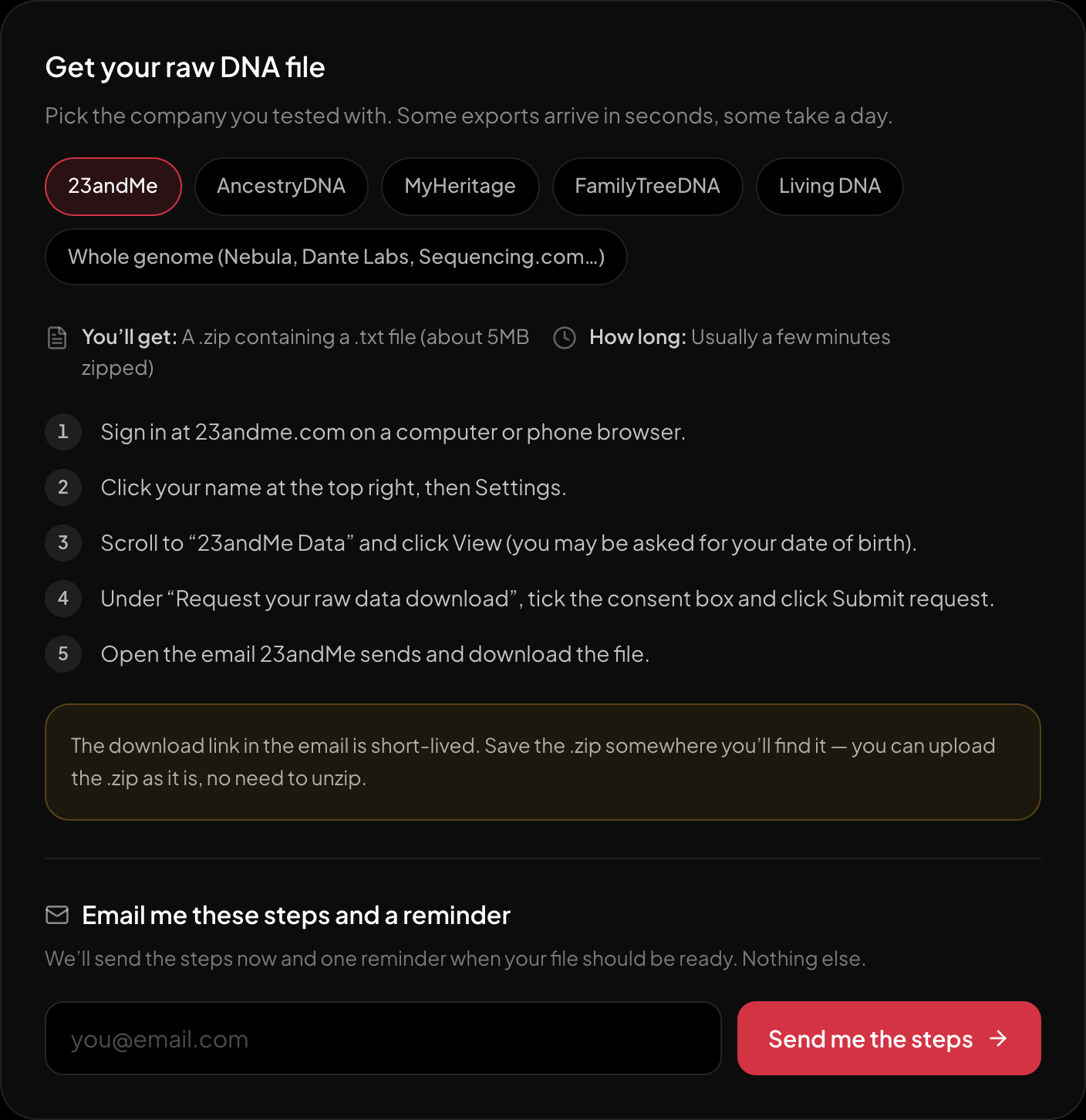
The download steps for 23andMe, on the page itself.
Ancestry across 15 regions and 157 reference populations.
The tool also reports a few related things: the TCF7L2 finding, which bears on how you handle refined carbs, and, for people who stored their file, a type 2 diabetes polygenic tendency in Ask your DNA, placed among the 1000 Genomes people (relative, not a prediction). Neither predicts how metformin will work for you.
New to raw DNA files? Start with the full guide: 23andMe Raw Data Interpretation Free in Your Browser
Written by
HealthOSX Research