Does My 23andMe or AncestryDNA Raw Data Show Which Allele Came From My Mother and Which From My Father
A raw file from 23andMe or AncestryDNA lists both letters at each position but never which parent gave which. Here is what phasing can and cannot add, what to do next, and when it matters.
No. A 23andMe or AncestryDNA raw data file lists the two letters you carry at each position, such as AG, but not which came from your mother and which from your father, and the order of the letters means nothing. An unphased VCF says the same thing with 0/1. Phasing (from a reference panel or long reads) can tell which letters travel together on one copy; only a parent's DNA, or matches to known relatives, can say which copy is whose.
The chip measures each position alone, and allele order is arbitrary
A 23andMe file has four columns: rsid, chromosome, position, genotype. AncestryDNA splits the genotype into allele1 and allele2. People often read allele1 as the maternal one. It is not. The order is a formatting choice, and the file contains no parent-of-origin information at all. The chip reports the mix of the two copies you carry at each spot and nothing about how neighbouring spots relate.
There is a second problem. Even if you somehow knew that the A at one position was your mother's, the chip gives you no way to say whether the G at the next position is on that same chromosome copy. That link is what phasing recovers. A chip reads roughly 600,000 to 700,000 positions, and each one is an independent measurement.
| File | Example | Phased? | Parent labelled? |
|---|---|---|---|
| 23andMe raw data | AG | No | No |
| AncestryDNA raw data | allele1 A, allele2 G | No | No |
| Unphased VCF | 0/1 | No | No |
| Phased VCF | 0|1 | Yes | Only if the pipeline says so |
Scroll the table sideways for the rest →
Phase tells you which alleles share a chromosome copy. Parent labels need parents' data or a documented pipeline.
AncestryDNA's website has a feature called SideView that splits your ethnicity estimate into two sides, Parent 1 and Parent 2, without either parent being tested. It works by phasing your DNA and using your DNA matches to place segments on one side or the other. It is a site feature, the Parent 1 and Parent 2 labels are arbitrary and do not tell you which side is your mother's, and none of it is in the raw download, which holds the same columns for everyone.
The slash and the pipe in a VCF
In a VCF, the GT field is where this shows. 0/1 means one reference allele and one alternate allele, with no statement about which chromosome copy carries which. 0|1 means the genotype is phased: the two alleles sit on separate chromosome copies, in the order written. Phased GT can come from whole-genome sequencing, and it can also come from imputation or phasing output run on chip data. Alleles in neighbouring phased records are on the same copy only within the same phase set, marked by the PS tag or by the same phase block. Across blocks, the left sides are not linked, so the first allele of one block says nothing about the first allele of the next.
A pipe does not by itself say maternal or paternal. Some trio pipelines put one parent first, but that is a convention of the pipeline, not of the format. Check its documentation before assuming. Most phased files from population tools label the two sides arbitrarily.
Three ways phasing actually works
- Parents' genotypes (a trio). If the father is AA, the mother is GG and you are AG, the A is his and the G is hers. Every site where a parent's genotype rules out an allele is assigned to a parent, so all the father-assigned alleles together form the paternal haplotype automatically, and the mother-assigned ones form the maternal haplotype. Sites where parent and child are all heterozygous stay unresolved and need statistical or read-based phasing.
- Statistical phasing. Tools such as SHAPEIT, Beagle and Eagle compare your stretches of DNA with haplotypes seen in a large reference panel and pick the most plausible pairing. This is how chip data is normally phased. It is good for common variants over short distances, weaker for rare ones, and tends to be worse for ancestries the panel covers thinly. It labels the copies haplotype 1 and 2, not mother and father, and it makes occasional switch errors where the pairing flips partway along a chromosome.
- Long reads. Sequencing technologies that read many thousands of bases in one piece see two variants on the same molecule directly. That gives phase blocks without any reference panel. Without parents' data the blocks still carry no parental label.
| Father | Mother | Where the A and G came from | Resolved? |
|---|---|---|---|
| AA | GG | A from father, G from mother | Yes |
| AA | AG | Father must give A, so G from mother | Yes |
| AG | GG | Mother must give G, so A from father | Yes |
| AG | AG | Either parent could have given either letter | No |
| AG | Not tested | Cannot tell from the father alone | No |
Scroll the table sideways for the rest →
Child is AG in each row. The logic is exact; it resolves the child's alleles in rows where at least one parent is homozygous.
What to do if you want to know
- 1.Get a parent's raw file and compare position by position. Take a site where one parent is homozygous. If your father is AA and you are AG, he can only have given an A, so your G came from your mother. If your father is AG and your mother is GG, your mother gave a G, so your A came from your father. Repeat this across every site where at least one parent is homozygous, and the resolved alleles line up into a paternal and a maternal haplotype.
- 2.Phase the sites that remain unresolved. Trio resolution is done by the simple comparison in step 1; statistical phasing then handles the remaining sites, such as those where everyone is heterozygous. Beagle 5 and Eagle do not take pedigree or trio input, so they give you haplotype 1 and 2 with no parental label. A tool that does use family data, such as SHAPEIT2 with duoHMM, may be able to use your parent's genotypes, but check its documentation for your data type. The practical work is to convert the raw file to VCF, match the reference panel's genome build (GRCh37 or GRCh38), and download a reference panel such as 1000 Genomes.
- 3.If no parent can be tested, use relatives. Shared segments with relatives known to be on one side, such as a maternal aunt or a paternal cousin, can assign those segments to a parent. This is how the companies' parent splits work, and it only covers the stretches where such a relative matches you.
- 4.For a clinical question about two variants in one gene, ask the ordering clinician. Request parental testing or a long-read assay. Those are the routes a lab can use to report whether the variants are in cis or in trans.
When it matters: two variants in the same gene
The case that matters most is two different variants in one gene. If they sit on the same chromosome copy (in cis), your other copy is untouched. If they sit on opposite copies (in trans) and both variants are damaging, neither copy works fully. In a recessive condition that is the difference between being a carrier and being affected, and an unphased file lists the same two genotypes either way. This is called compound heterozygosity, and labs settle it by testing the parents or by long reads.
It also matters for drug-metabolising genes. Star alleles such as those used for CYP2C19 are defined as haplotypes, so a diplotype call from unphased data assumes the most common arrangement of the variants. Usually that is right. It is an assumption, not a measurement.
For nearly all variants on their own, phase changes nothing. You carry one copy of it or two, and the effect is the same whichever parent it came from. The exception is a small set of imprinted genes, where the parent of origin changes whether the copy is active. For most variants in a consumer file that is irrelevant. Where it is relevant, the question can be resolved by testing a parent or, for some imprinting disorders, by methylation testing.
What you can tell without phasing
- If your genotype is homozygous, say AA, both parents gave an A. No phasing needed.
- If one parent's genotype is known and it excludes an allele, the other allele came from the other parent.
- Mitochondrial DNA comes from your mother only. The Y chromosome comes from your father only, so only men carry one.
- In men, the X chromosome appears as single or homozygous calls and, outside the small pseudoautosomal regions, is entirely maternal. It is the one place a raw file gives parent of origin for free.
A genotype tells you which two letters you carry. Phasing tells you which letters travel together, and only a parent tells you whose they are.
What the free reader can and cannot show
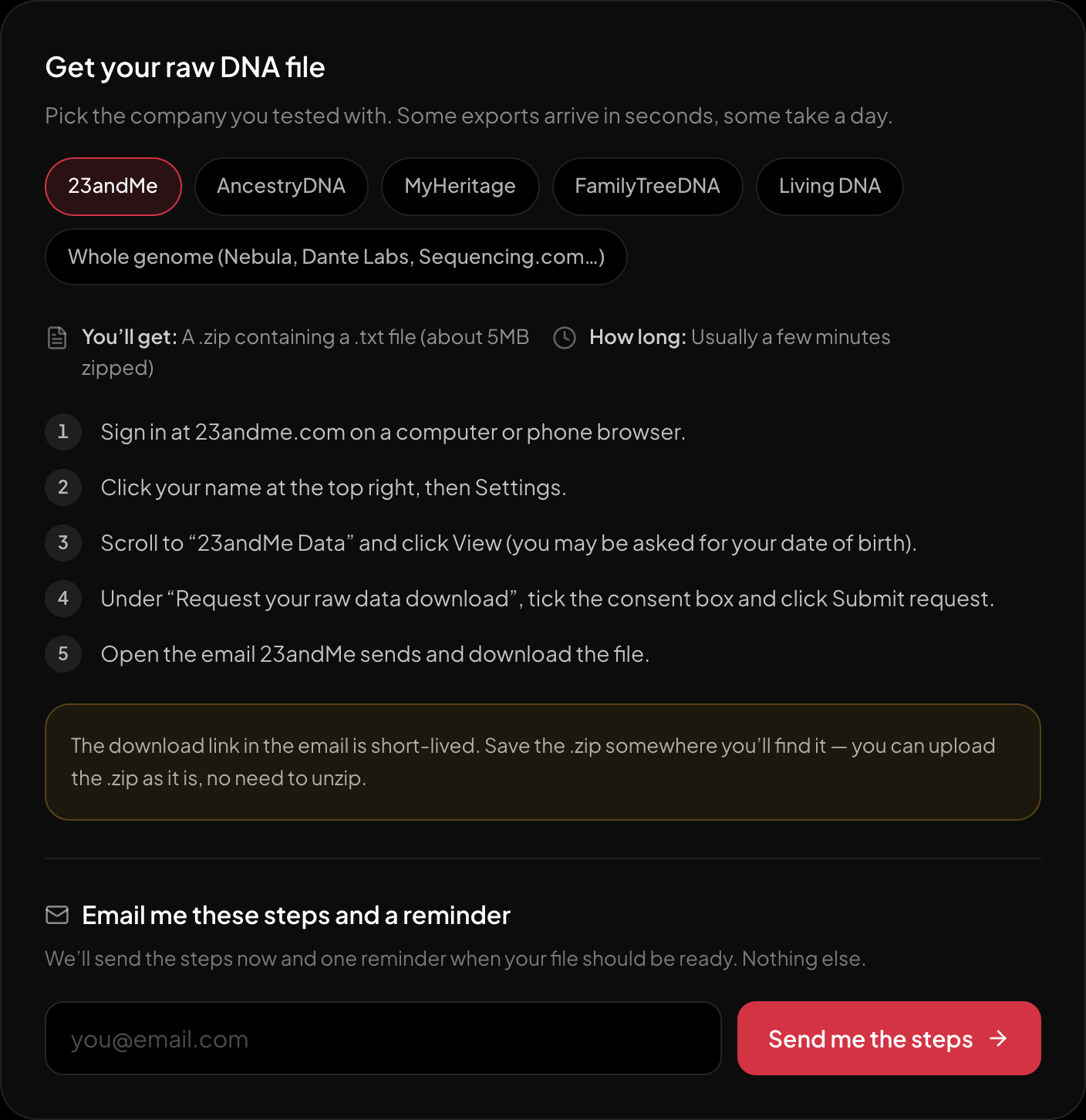
The download steps for 23andMe, on the page itself.
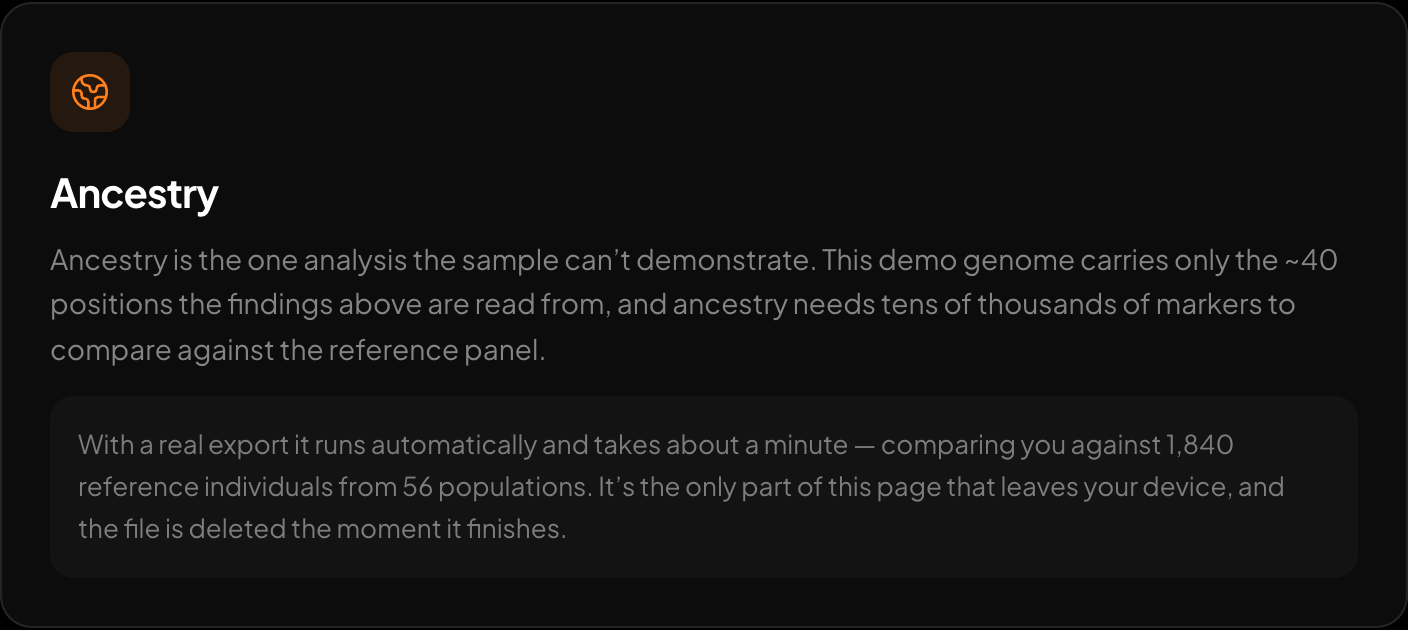
Ancestry across 15 regions and 157 reference populations.
The free reader at healthosx.com/dna takes a 23andMe, AncestryDNA, MyHeritage, FamilyTreeDNA, LivingDNA or WeGene file, or a whole-genome sequencing VCF, and parses it in your browser. It reports traits, medication response and carrier-relevant findings, plus your maternal line from mitochondrial DNA and, if you have a Y chromosome, your paternal line. It works from the genotypes as written, so it shows exactly which letters you have and in how many copies, which is the starting point for deciding whether phasing is worth asking about. It will not phase your genome, it cannot tell you which parent gave a given variant, and it cannot say whether two variants in one gene are in cis or in trans. Treat any finding that depends on that as a question for a clinical lab.
New to raw DNA files? Start with the full guide: 23andMe Raw Data Interpretation Free in Your Browser
Written by
HealthOSX Research