Can My 23andMe or AncestryDNA Raw Data Show If I Carry the Cystic Fibrosis Gene (CFTR F508del)
A 23andMe raw file can show F508del, the commonest cystic fibrosis variant, if the chip covers it. A normal result still does not rule out carrying another CFTR variant.
Sometimes. A 23andMe raw data file can show whether you carry F508del, the best-known cystic fibrosis variant in the CFTR gene, if the chip included that position. Ancestry-focused chips such as AncestryDNA carry few or no CFTR variants, so they are much less likely to. One deletion copy means you are a carrier. A normal or missing result does not mean you are not, because a chip reads only a limited set of CFTR variants.
If you bought 23andMe's Health + Ancestry service, check first whether your account already includes the FDA-authorized cystic fibrosis carrier status report, which covers a defined list of CFTR variants. Its current documentation gives the exact number. That report is a better first stop than the raw file. The rest of this post is for people who only have the raw file, or who want to see what it holds.
How to find F508del in your raw file
The raw file is a plain text table: an ID, a chromosome, a position and a genotype. There are no gene names in it, so searching for "CFTR" finds nothing. CFTR sits on chromosome 7.
To look F508del up, open the file in a text editor or spreadsheet and search for rs113993960. Some files label the same position with a different ID, such as a 23andMe i-number, so a missing rsID does not prove the position is absent. If the search finds nothing, filter chromosome 7 and search by position for entries inside the CFTR gene, which spans roughly chr7:117,120,000-117,309,000 on GRCh37 (build 37). Coordinates differ on GRCh38, and the exact F508del position depends on the build, so check which build your file uses, which is usually stated in the header, and match it to the rsID's listing for that build.
Because F508del is a deletion, not a swapped letter, the genotype is usually written with D and I. I means the normal sequence is present, D means the three bases are deleted:
- II: no F508del copy found.
- DI: one deletion copy. You carry F508del.
- DD: two copies. That would mean cystic fibrosis, and anyone with it would almost certainly know already. A chip result like this needs clinical confirmation.
- --: no call. The chip did not read it, which says nothing either way.
Letter conventions vary between file versions, so check the header of your file before trusting a reading.
What a carrier actually is
CFTR builds a channel that moves chloride across the surface of cells in the lungs, pancreas and sweat glands. F508del removes one amino acid, phenylalanine at position 508. The three deleted bases span codons 507 and 508, and isoleucine 507 is kept through a synonymous codon, so the net effect is the loss of phenylalanine 508 and the rest of the gene stays in frame. The protein is made, but it misfolds and most of it is destroyed before it reaches the cell surface.
Cystic fibrosis is recessive. With two non-working copies there is too little channel, mucus turns thick and sticky, and the lungs and pancreas suffer. With one non-working copy and one normal copy, the normal copy makes enough channel. Carriers are usually healthy, but carrying a CFTR variant has been linked to modestly higher rates of pancreatitis, chronic sinusitis and, in men, congenital absence of the vas deferens.
F508del is the best known because it is the commonest. It accounts for roughly 70% of cystic fibrosis alleles in people of European ancestry, and about 1 in 25 people of northern European ancestry carry some CFTR variant. It is rarer in many other populations, where other variants matter more.
Why a chip sees only part of CFTR
More than 2,000 CFTR variants have been reported, and several hundred of them are confirmed to cause cystic fibrosis (source: the CFTR2 project, run by the Cystic Fibrosis Foundation, Johns Hopkins University and the Hospital for Sick Children, Toronto; figure as of November 2026). A genotyping chip is built from a fixed list of positions. Recent 23andMe chips carry a limited set of CFTR variants, while ancestry-only chips like AncestryDNA carry few or none. Which ones you get depends on the chip version. Deletions and insertions are also harder to put on a chip than single-letter changes, which is why F508del can be missing.
| Sees F508del | Sees rarer CFTR variants | Clinically validated | |
|---|---|---|---|
| 23andMe raw file (recent chips) | Often | A limited set | No |
| AncestryDNA raw file | Not reliably present | Few or none | No |
| Clinical carrier panel | Yes | Many | Yes |
| Whole-genome VCF | Yes | Yes, if called | Not by itself |
Scroll the table sideways for the rest →
Illustrative pattern, not an audit of specific files. Exact coverage depends on the chip version or test, and clinical panel and sequencing depth vary by lab.
So the result is lopsided. A DI is informative. An II only says that the variants on the chip were not seen.
A normal result is not an all-clear
This is the mistake people make most. Reading "no F508del" as "not a carrier" skips the rest of the gene. A worked example, as an approximate calculation for northern European ancestry: start with a 1 in 25 chance of being a carrier, and assume F508del accounts for about 70% of carrier alleles. This assumes the F508del position was actually read in your file, meaning a genotype of II and not --. A negative F508del result removes most of the risk, but about 30% of carriers have a different variant. That leaves roughly 1 in 80 chance of still being a carrier. The residual is bigger if your ancestry is not northern European, because the common variants differ and chip and panel designs lean toward European ones.
The usual routes to a fuller answer:
- A clinical carrier panel, which checks dozens to hundreds of CFTR variants in a validated lab test, often with a doctor or genetic counsellor involved.
- Sequencing the whole CFTR gene, which finds rare variants a panel misses.
- A whole-genome VCF, which covers the gene end to end. The free HealthOSX tool screens a whole-genome VCF in your browser against ClinVar, including an expanded carrier screen panel, with no file storage needed. A clear result there means no pathogenic variant was called in the file, and that is still not a diagnostic all-clear. Some CFTR features, such as the poly-T/TG tract that modifies the effect of some variants, and large deletions, are not reliably called from short-read VCFs.
One caution in the other direction: a raw-file DI is a consumer-grade call. It is a strong hint, but a clinic will repeat it before anyone makes a decision from it.
What it means for a partner or a pregnancy
Your result matters mainly in combination with your partner's. If both of you carry a CFTR variant, each pregnancy has a 1 in 4 chance of a child with cystic fibrosis, a 1 in 2 chance of a carrier like you, and a 1 in 4 chance of neither.
If you are a carrier and your partner is not, a child cannot have cystic fibrosis through this route in practice, but can inherit your variant half the time. Your partner's raw file does not settle it either, for the coverage reasons above. The honest step is a proper carrier test for them, and a genetic counsellor can tell you how much residual risk a negative one leaves. Many countries also screen newborns for cystic fibrosis, and a sweat test is the standard way to diagnose it.
A raw file can prove you carry F508del. It cannot prove you do not carry any CFTR variant.
Looking at your own file
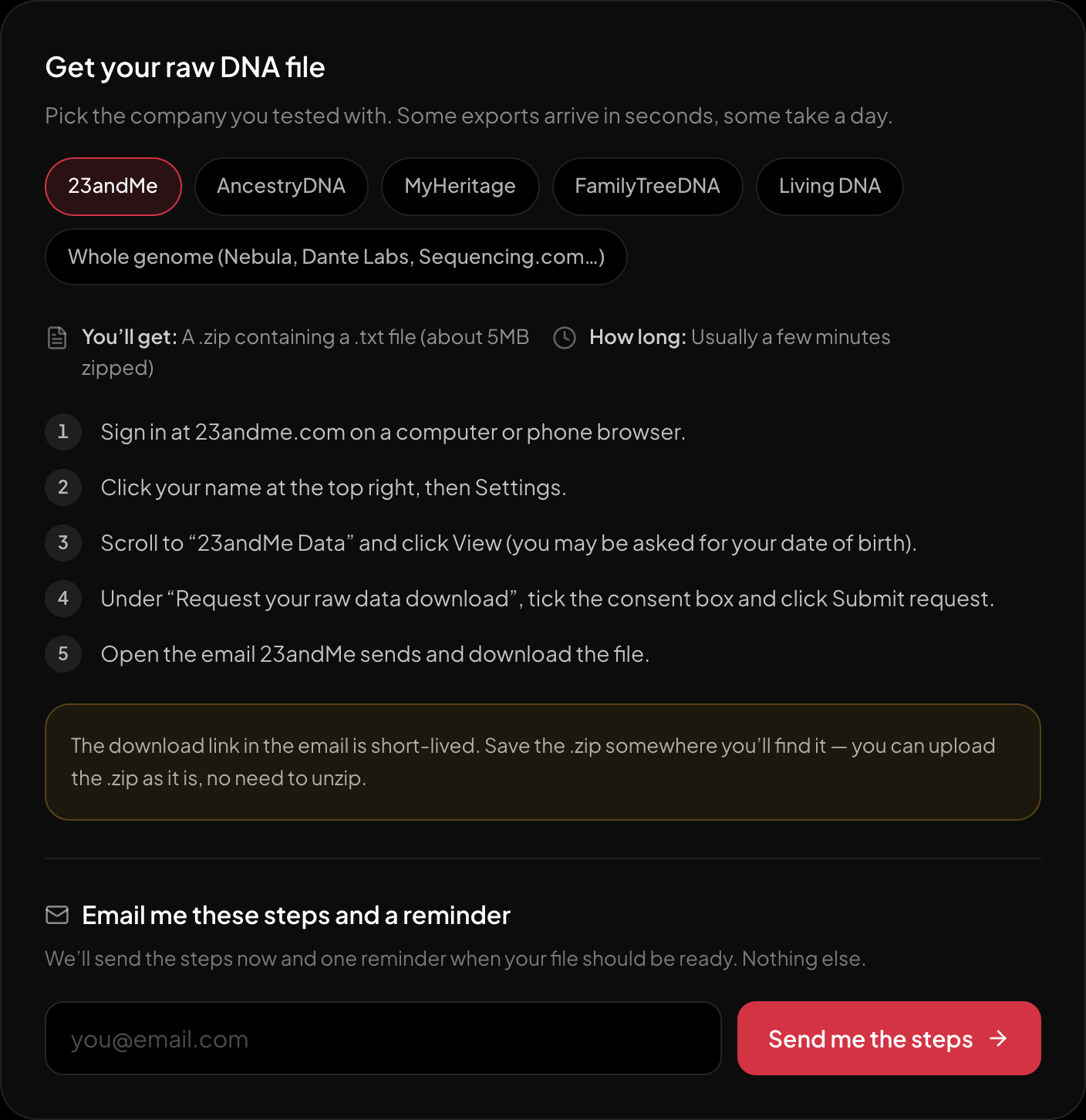
The download steps for 23andMe, on the page itself.
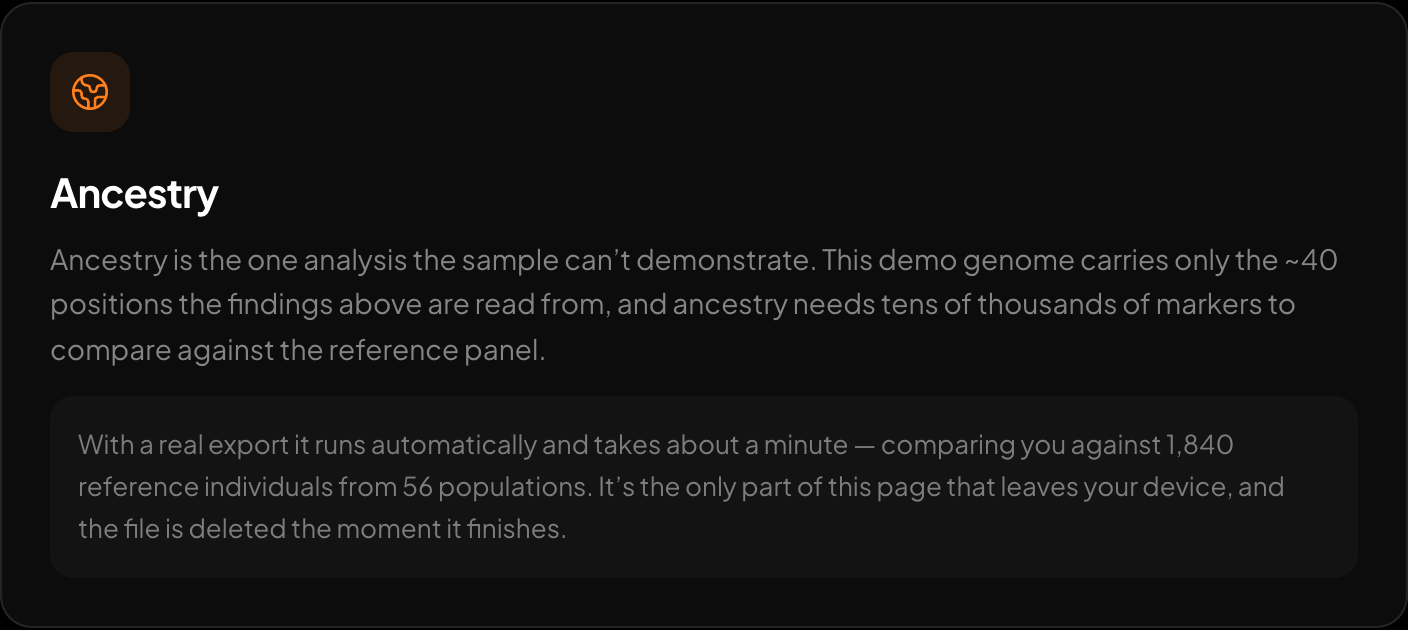
Ancestry across 15 regions and 157 reference populations.
If you want to see this in your own numbers, the free DNA tool at healthosx.com/dna reads a 23andMe, AncestryDNA or MyHeritage raw file, or a whole-genome VCF, in your browser. For a whole-genome VCF it screens against ClinVar, including an expanded carrier screen panel, with no file storage needed. A clear panel is not a diagnostic all-clear. Use healthosx.com/dna/check to see whether your file will work with the tool, and healthosx.com/dna/lookup to read a single rsID such as rs113993960. The main report has no CFTR finding, so for a chip file the single-variant lookup is the useful part. This is a way to look and to arrive at a clinic with a better question, not a replacement for a carrier test.
New to raw DNA files? Start with the full guide: 23andMe Raw Data Interpretation Free in Your Browser
Written by
HealthOSX Research